3 months of fear since the TIA. 4 sentences from the hospital: "Take your medication and rest." N450,000 on the hospital stay and medications. Zero on a daily system that fills the 90 days between neurologist appointments. The man who built a career on being unshakeable was shaken by his own heartbeat. Now the heartbeat has a monitor. The medication has a schedule. The stress has a technique. The warning signs have a protocol. The fear has not disappeared — the fear is rational, the risk is real. But the fear has a system now. And a fear with a system is vigilance. Vigilance is how you live fully. Alongside your neurologist.
"'Rest' is a word. Vigilance is a system."
"The man who was discharged with 4 sentences now has a 5-pillar daily system. Blood pressure: monitored morning and evening. Medication: on time, every time. Hydration: tracked. Stress: managed with a 90-second technique nobody can see. Warning signs: known, rehearsed, printed, and in my wallet. The 90 days between appointments are no longer empty. They are managed. Every day. Alongside my neurologist."
Your Protocol Is Ready
Click below to download the complete protocol and both bonus guides instantly.
Download Your Guides NowPrint This Immediately
F — Face drooping? A — Arm weakness? S — Speech slurred? T — Time: CALL NOW.
Also: sudden severe headache, vision changes, confusion, loss of balance.
If ANY sign appears: CALL EMERGENCY SERVICES IMMEDIATELY. DO NOT WAIT.
Here's What You Got
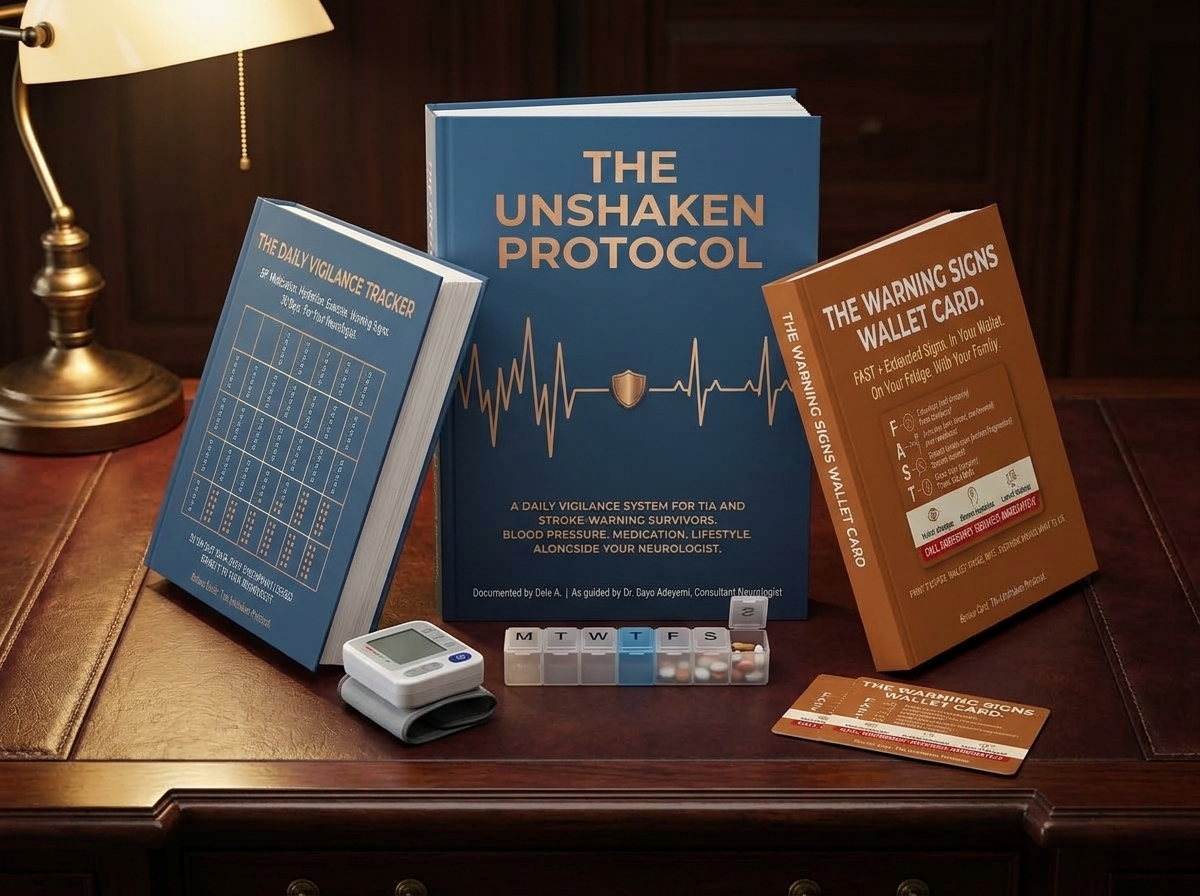
Blood Pressure Protocol (morning + evening readings, target ranges). Medication Management (timing, sequencing, compliance). Daily Lifestyle Protocol (hydration, nutrition, safe movement, sleep). The 90-Second Stress Technique. Warning Signs Protocol (FAST + extended signs). Alongside your neurologist
30-day log: BP readings, medication timing, hydration, exercise, warning signs. Data for your neurologist. Bring it to every appointment
FAST + extended signs. Wallet-sized. Print 3 copies: one for you, one for your wife, one for your driver or PA. Everyone knows what to do
Your First 48 Hours
Download Everything Now
Tap the button above. Save all 3 files. The main protocol is your complete 5-pillar system. The Tracker starts tomorrow morning. The Wallet Card gets printed tonight.
Print the Warning Signs Wallet Card Tonight (Bonus #2)
This is the most urgent item. Print 3 copies. Put one in your wallet. Give one to your wife. Give one to your driver or PA. The FAST protocol and extended signs — everyone around you needs to know what to look for and what to do. This card is not for you alone. If a second episode begins, you may not be able to act. The people around you act. Arm them tonight.
Read the Blood Pressure Protocol Tonight
Open the protocol. Turn to Pillar 1: Blood Pressure. Read how to measure correctly (time, position, cuff placement). Learn what your post-TIA target range is (your neurologist sets the target — the protocol teaches you how to read it). Tomorrow morning: take your first logged reading. Write it in the Tracker. The daily data begins.
Set Up the Medication System Tomorrow Morning
Turn to Pillar 2: Medication Management. Read through each medication you take. Understand what each one does. Set phone alarms for each medication time. Get a daily pill organiser (the protocol recommends the 7-day type). Fill it for the week. The system turns compliance from "remembering" to "routine." You do not think about it. The alarm rings. The compartment opens. The pill is taken. Done.
Learn the 90-Second Stress Technique by Day 3
Turn to Pillar 4. Read the stress technique. It takes 90 seconds. It is invisible — you can do it in a board meeting, in traffic, in a difficult conversation. Nobody sees it. Your blood pressure benefits. Practice it 3 times on Day 3. By Day 7, it should be automatic. The next time stress spikes — and it will, you are a working professional — the technique is ready.
Your First 30 Days
Do This Right Now
Print the Warning Signs Wallet Card. 3 copies. That takes 2 minutes. Then open the protocol. Turn to Pillar 1: Blood Pressure. Read it once. Tomorrow morning: take your first reading. Log it in the Tracker. That is Day 1. The vigilance system is active. Every day from here is monitored. Every number is logged. The fear meets data. And data is stronger than fear.
"The Wallet Card tonight. The BP reading tomorrow morning. The system is live. Alongside your neurologist."

Need Help?
Question about the BP readings? Not sure about the stress technique? Need guidance on the medication schedule? Every message answered. Alongside your neurologist for all medical decisions.